Adapt For Access
Adapt For Access
There’s a point where everything still looks solid.
The Anchor is clear.
The outcomes are set.
Now comes the step that actually determines whether it will work in a real classroom:
Adapt and Apply.
Adapt the content.
Not by watering it down - but by taking essential, mandated curriculum…
and shaping it so it can live inside the theme.
A maths concept becomes part of designing a space.
A writing skill becomes part of pitching an idea.
Same content.
Different context.
Then Apply.
And this is where things often fall short.
Because students don’t all think the same way.
Some need to build.
Some need to talk it through.
Some need structure before they can move.
If that isn’t planned for… you feel it quickly.
A lesson might start like this:
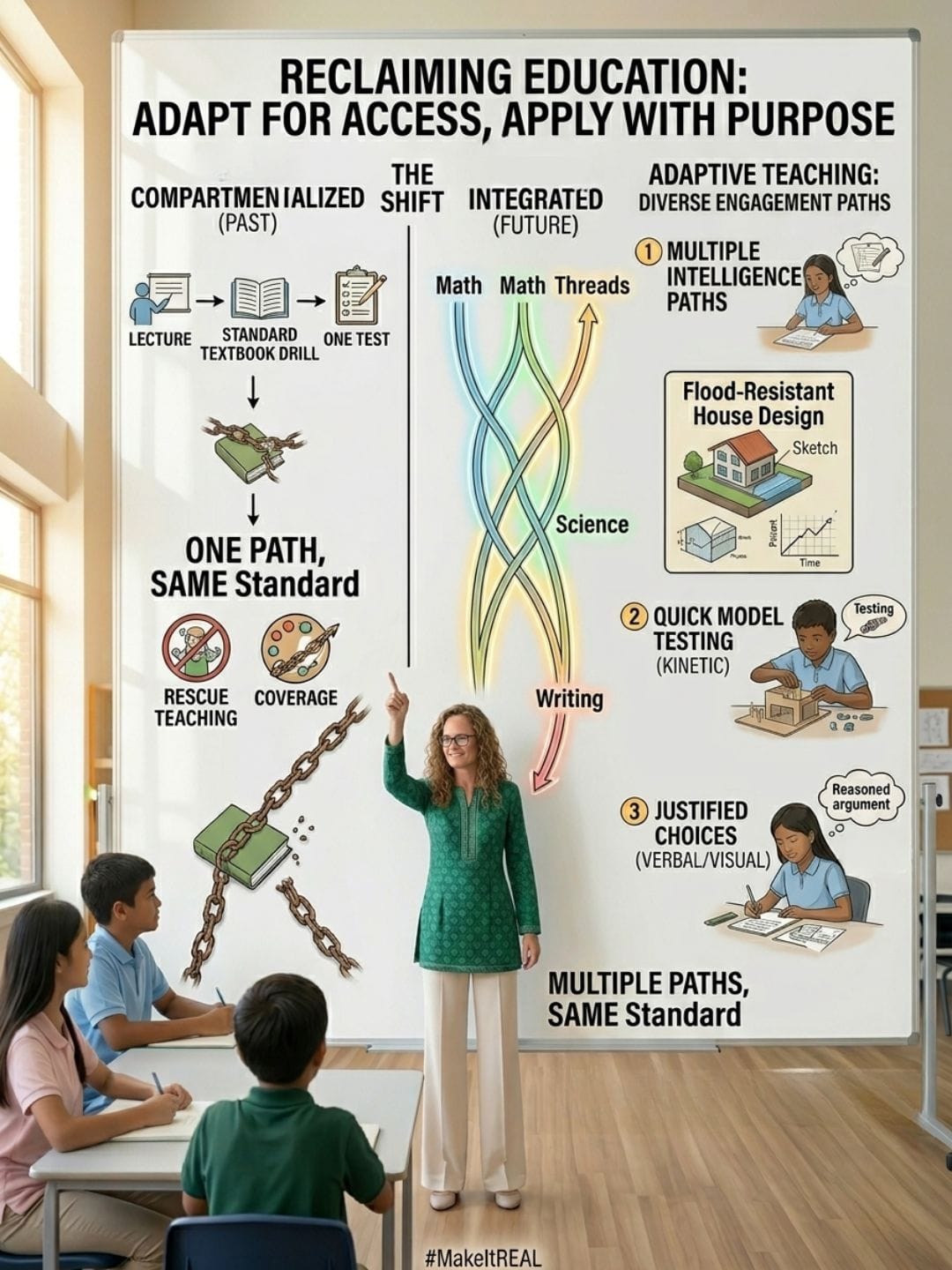
Students are designing a flood-resistant house.
One group sketches and labels their ideas straight away.
Another stares at the page, unsure where to begin.
Another rushes ahead with something unrealistic.
This is where adaptive teaching matters.
You step in.
You scaffold.
You question.
You redirect.
That’s good teaching.
But here’s the shift.
When Adapt and Apply are built in from the start…
you’re not rescuing the lesson.... You’re extending it.
Because the task was designed with range in mind.
The same activity might now look like this:
one student uses a template to structure their design
another builds a quick model to test an idea
another writes a short justification for their choices
Same goal.
Different entry points.
Now your in-the-moment decisions aren’t about fixing access.
They’re about deepening thinking.
This also changes what practice looks like.
Students don’t just complete a task and move on.
They come back to it.
They improve it.
They test whether it actually works.
A first design fails.
They adjust.
A second version is stronger.
They explain why.
That’s not repetition.
That’s development.
And this is where “real-world” starts to matter.
Not because the task is impressive.
But because it requires decisions.
Trade-offs.
Judgement.
When this step is working, you feel the difference.
Students are not all doing the same thing.
But they are all working toward the same standard.
You’re not constantly trying to catch students up.
You’re pushing them forward.
Have you adapted content so it fits the context…
and applied it in ways that actually reach the range of learners in your room?
Or are you relying on in-the-moment support to carry the load?



realeduco.com All Rights Reserved