Harnessing Multiple Intelligences to Fuel Choice, Autonomy, and Classroom Energy
Harnessing Multiple Intelligences to Fuel Choice, Autonomy, and Classroom Energy
What if we stopped asking, “What subject am I teaching?” and started asking, “Who am I reaching?”
When engagement fades, learning follows.
I know the struggles we face, as teachers, to engage a whole class of students all day, every day - the cliche of “you can’t please everyone all the time” comes to mind... But is it okay to step back and make peace with it?
Imagine visiting a doctor who, after a brief exam, can’t identify the cause of your symptoms and says, “Well, I can’t please everyone,” before sending you home. I’d call that negligence. So, if a student is disengaged, should we accept it when a teacher simply presses on?
Teaching, like medicine, requires adaptation, not assumption.
I get it, though, teachers are already overworked and drained by all the demands and pressures to get it right - all the time - for everyone… It’s a big ask.
But teaching is a big job.
So, how do we progress from teaching content to truly reaching students?
We start by recognising that reaching more students means teaching more flexibly.
We understand that intelligence is not one-dimensional; we plan for the differences.
To do that well, we need to understand how our students think, process, and create best… I use Howard Gardner’s Multiple Intelligences (MI) Theory as a lens to understand my students and their unique profiles, as well as a framework to plan lessons that are both integrated and inclusive.
MI Theory suggests that we all possess a range of intelligences, some being more dominant than others. Once I identify which intelligence types are most dominant in my students, I can design activities that connect with how they learn best and offer more meaningful opportunities for them to engage with the content.
In my role as a middle school teacher at a school for gifted students in South Africa, I developed a new curriculum each term, built around a theme chosen by the students. I taught content in context through an integrated, thematic approach, and I designed daily activities to develop essential skills using the MI framework so every student felt seen and challenged at some point in the day.
We didn’t follow a rigid timetable or rely on textbooks and repetitive worksheets. Instead, we explored exciting and meaningful topics that the students were genuinely invested in, in ways that sparked excitement and resulted in a deeper learning experience for everyone. From the first bell to the last, we spent the day calculating, reading, debating, designing, and answering philosophical questions about whatever topic it was that we were covering - we played (or made) music, developed inventions, wrote poetry, treasure hunted, and turned abstract concepts into concrete understanding.
Students with a range of neurodiverse and neurotypical behaviours, all in one classroom, achieving the same learning outcomes, and all genuinely enjoying school - we made that happen.
You might be thinking how great that sounds in theory, but know full well that you don’t have the freedom to toss the timetable or rewrite the curriculum.
I get it, most schools are part of a bigger system that works within constraints, but there are still ways to apply the principles of MI Theory and integrate your content contextually and effectively in a structured environment using a standardized curriculum.
Or are you about to scroll on because you think you can’t possibly find the time to change the way you plan, prep, and teach?
Stop.
Breathe.
You can do this - it’s just differentiation.
Differentiation doesn’t mean creating more work; it means creating more access.
One simple way to begin is by offering your students multiple ways to show what they know. You don’t need to make huge changes immediately. Present the maths problems, read the poems, study the chemical properties - and then give your students choices in how they engage with and express their learning.
Will they write a report, create a comic strip, record a podcast, design an infographic, or develop a prototype that solves a real-world problem?
You’re still assessing the same learning outcomes, but you’re allowing students to tap into their unique strengths and interests.
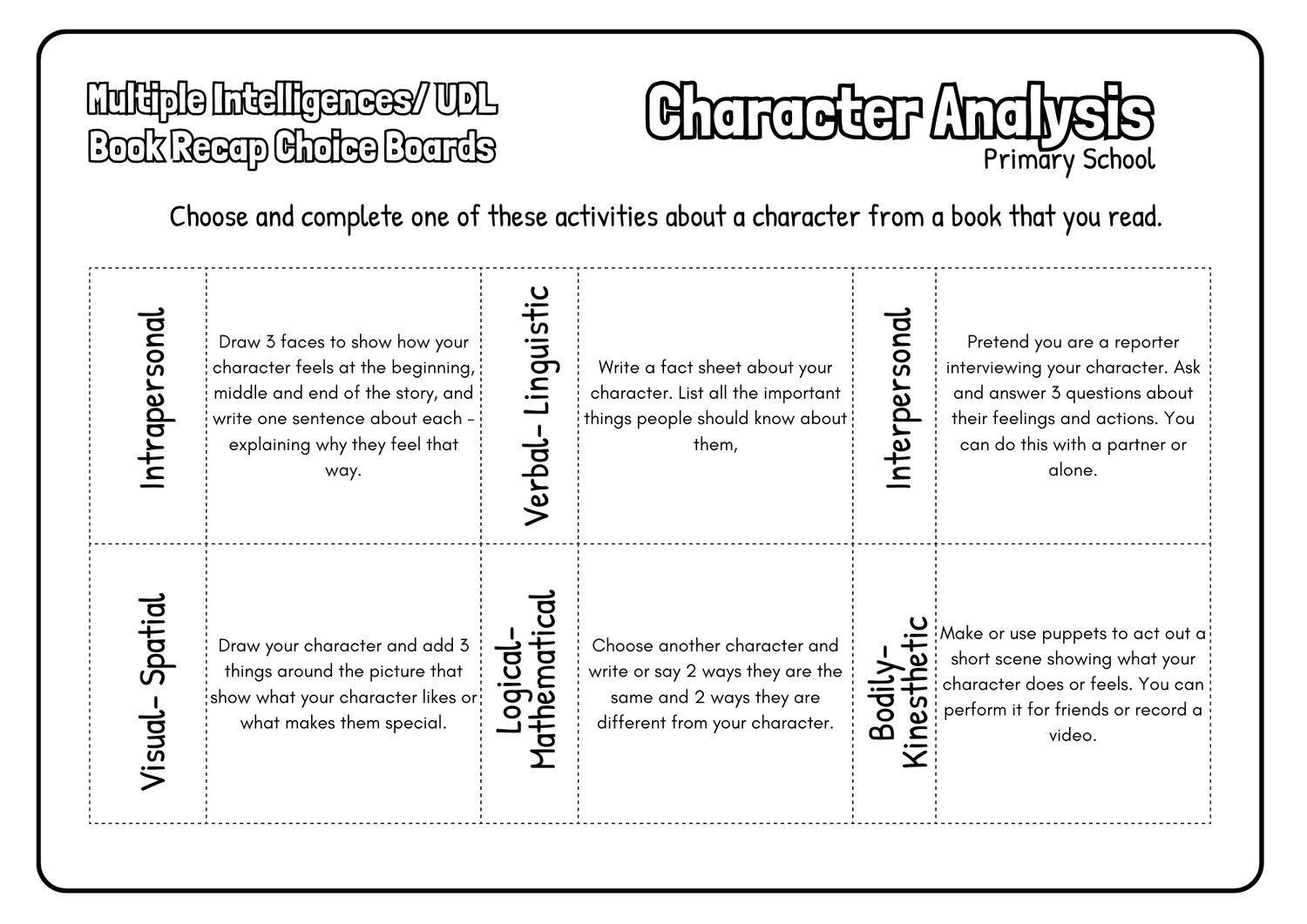
A lesson analysing a character for a book review doesn’t have to end in a worksheet with a general description of the student’s favorite character…
Instead - could students depict the different feelings that a character felt at different parts of the story, draw their interpretation of the character with their favorite things, or conduct an interview with them enquiring about their feelings or reactions to specific events in the book?
The content stays the same - analysing a character - the paths that students take just differ.
Choices provide autonomy, and students who choose to complete one activity over another are more likely to buy into it, own it, be engaged in the learning process… and that is when learning becomes authentic.
So, are you ready to cover curriculum content while uncovering student potential?
It doesn’t require a total overhaul, just a willingness to plan with purpose - for your students.
Start with one lesson.
Offer one choice board.
Watch one disengaged student lean in, light up, and come alive.
Sometimes, all it takes is one meaningful connection to change how a student sees themselves - and how they experience learning.
“If a child can’t learn the way we teach, maybe we should teach the way they learn.” - Ignacio Estrada
Do you agree?



realeduco.com All Rights Reserved