Level Up: Why Fair Isn't Always Equal
Level Up: Why Fair Isn't Always Equal
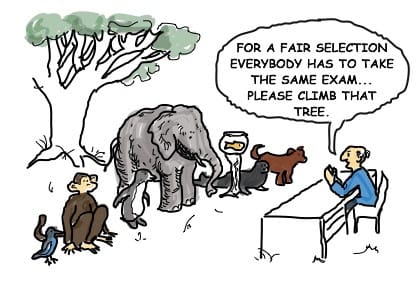
Many educators have seen the famous illustration of animals being told:
"For a fair selection, everybody has to take the same exam. Please climb that tree."
The monkey smiles.
The elephant hesitates.
The penguin looks confused.
And the fish has no chance at all.
The message is clear: treating every learner exactly the same is not always fair.
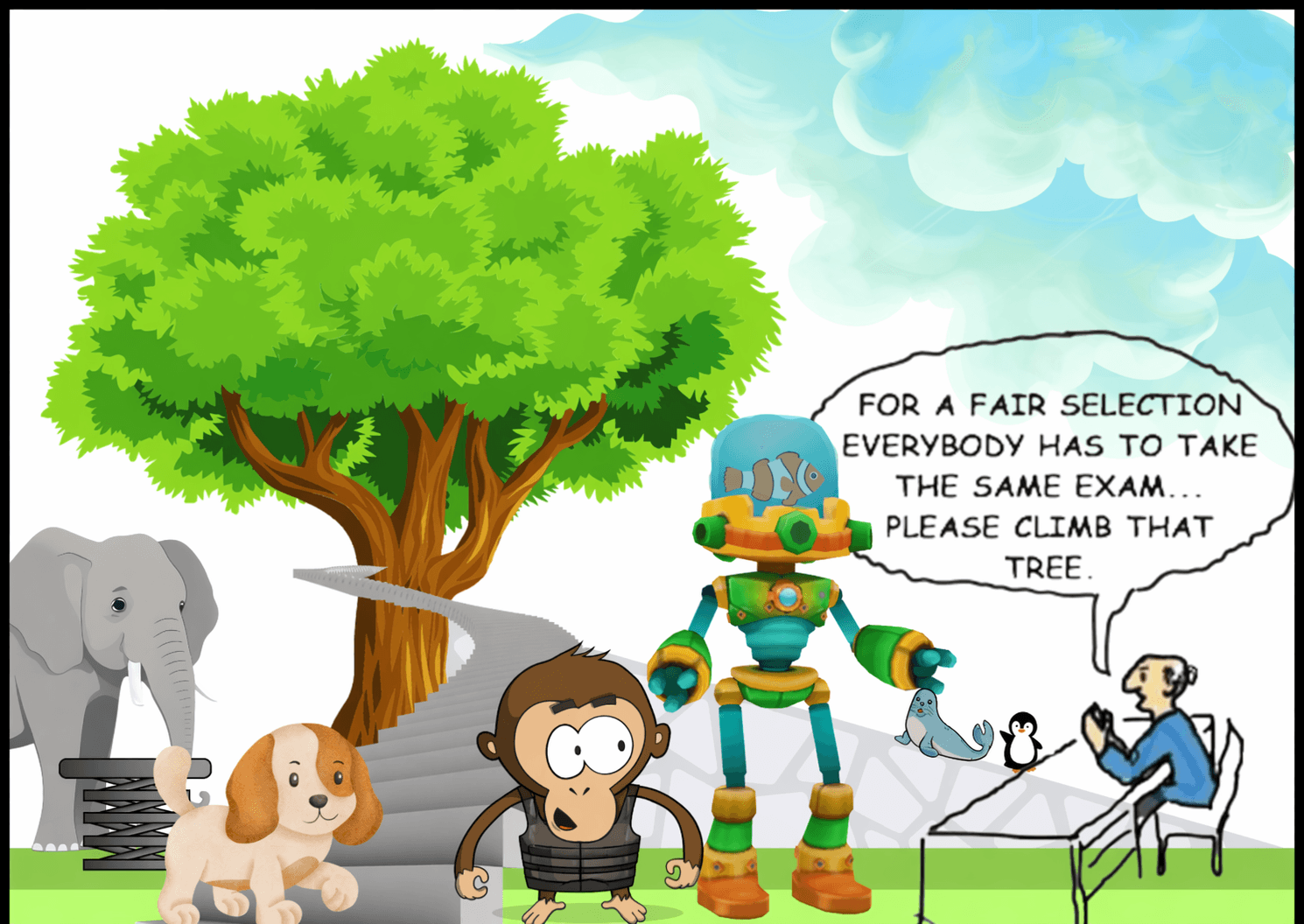
But what if we gave the fish a robotic suit?
Not one that magically carried it to the top of the tree.
Not one that removed all challenge.
A suit that allowed the fish to climb in a different way.
And what if we gave the monkey a weighted vest?
Not to make the task harder for the sake of being harder.
But to ensure that the monkey was challenged too.
Suddenly, both learners have obstacles to overcome.
Both have a goal to reach.
Both must solve problems, adapt, and persevere.
The fish must learn to navigate the robotic suit.
The monkey must learn to manage the additional weight.
The destination remains the same.
The challenge remains real.
The pathway simply looks different.
Fairness is not giving every learner the same challenge.
Fairness is ensuring every learner experiences an appropriate challenge.
Scaffolding Is Not Differentiation
These two terms are often used interchangeably, but they serve different purposes.
In our example, the robotic suit is a scaffold.
It provides support that enables the fish to attempt the same challenge as everyone else.
In the classroom, scaffolds might include:
sentence starters
graphic organisers
worked examples
teacher modelling
visual prompts
checklists
These supports help learners access the learning without changing the learning itself.
Differentiation is something different.
If we assessed the fish on how well it grips branches with its fins, it would still fail.
Instead, we assess how effectively it operates the suit to achieve the goal.
The destination remains the same.
The pathway and method of demonstrating success may change.
Why Level Up Happens Last
One of the biggest mistakes in curriculum design is beginning with differentiation.
Before we can decide who needs support or extension, we first need meaningful learning worth supporting.
In the REAL Method, we design the learning journey first.
Only then do we step back and ask:
Where might learners need additional support?
Which scaffolds could increase access?
Which students may require differentiated pathways?
Where can we provide deeper challenge?
This is the Level Up phase.
Extension Is Not More Work
Level Up is not only about supporting struggling learners.
It is also about challenging advanced learners appropriately.
Too often, extension means giving capable students more of the same work.
More questions.
More pages.
More repetition.
That is not extension.
True extension asks learners to think more deeply, explore greater complexity, solve authentic problems, and make meaningful connections.
The goal is not more work.
The goal is richer learning.
Fairness Means Access to Success
Fairness does not mean giving every learner the same task, the same support, or the same assessment.
Fairness means giving every learner a genuine opportunity to succeed.
Sometimes that means scaffolds.
Sometimes that means extension.
Sometimes that means differentiated assessments.
The goal is not to lower expectations.
The goal is to remove unnecessary barriers while maintaining meaningful challenge.
Because real learning is not about helping every learner climb the tree in exactly the same way.
It is about ensuring every learner has the opportunity to reach the top.



realeduco.com All Rights Reserved